PRODUCT · EXPLICIO CAMPUS · CONSULTING, TRAINING & APPLIED AI RESEARCH
Where our own fundamental AI research becomes turnkey industrial reality.
Software and hardware are only as strong as their integration into your operations. With Explicio Campus, our engineers and AI researchers support your company in person: from a strategic knowledge inventory and legally recognised AI training to the development of bespoke connectors for your plants, test rigs and measurement series.
At the same time, Campus opens up our own research workshop: download our complete whitepapers on reproducible GPU kernel decisions and on our own pair4 decision models free of charge, in German and English.
From knowledge architecture and AI training (EU AI Act Art. 4) to bespoke plant connectors and our published AI whitepapers from Detmold.
WHITEPAPERS & RESEARCH REPORTS · MEASURED ON REAL HARDWARE
Every number has a raw file. Read our research reports in the original.
Why do large language models flip even at temperature=0? And why does our small encoder, running on the CPU with 307 million parameters, beat large 35-billion-parameter models at the up-front decision? Here are our measurements, methods and limits – openly documented in German and English.
WHITEPAPER #01 · AS OF 20 SEPTEMBER 2026 · 15 PAGES · AUTHOR: CHRISTIAN THIEDE (ORCID 0009-0002-4517-7208)
Reproducible decisions on hardware that is not bit-stable
Safeguarding the decisions of an AI knowledge management system against inference kernel noise (measurements on NVIDIA GB10, vLLM 0.24.0, Qwen3.6-35B-A3B-NVFP4).
The measured problem: Twenty identical calls at temperature=0 on an idle server produce 17 different texts. The cause is not a server switch but the NVFP4 Marlin compute kernel in the expert block from layer 0 onwards (54 of 3.85 million tensor elements deviate minimally).
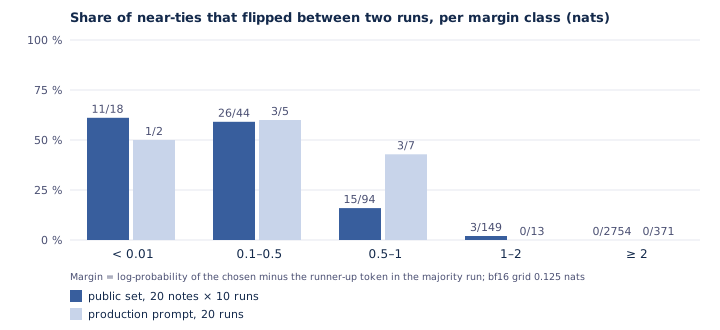
The 2-nats law: Our logprob probe proves across 5,478 measured token positions: decisions flip only at near-ties. If the margin between the best and second-best token is above 2 nats, not a single result flips in 0 of 5,478 positions.
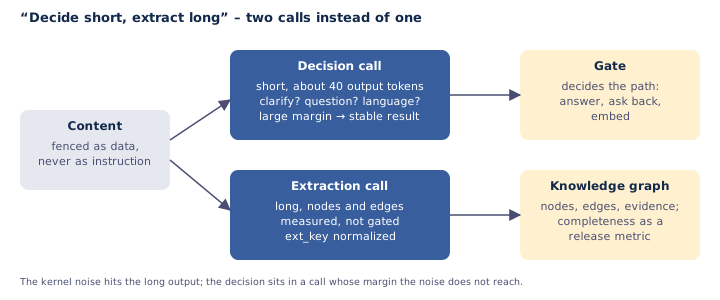
The Explicio solution: With the architecture pattern “short decision (~40 tokens), long extraction”, we move business-critical decisions (follow-up question? question? language?) to where the margin is large – with 8 of 8 stable operating cases and without the 7.4-fold time penalty of dense models.
Embedded figures
Figure 2: Share of near-ties that flipped between two runs, by margin class (nats)Figure 4: “Short decision, long extraction” – two calls instead of one
WHITEPAPER #02 · AS OF 6 OCTOBER 2026 · 17 PAGES · AUTHOR: CHRISTIAN THIEDE (ORCID 0009-0002-4517-7208)
Small, calibrated, verifiable – a workshop report on Explicio pair4
How Explicio develops its own multilingual decision models for intent, yes/no reading and follow-up questions, and runs them on the Box CPU.
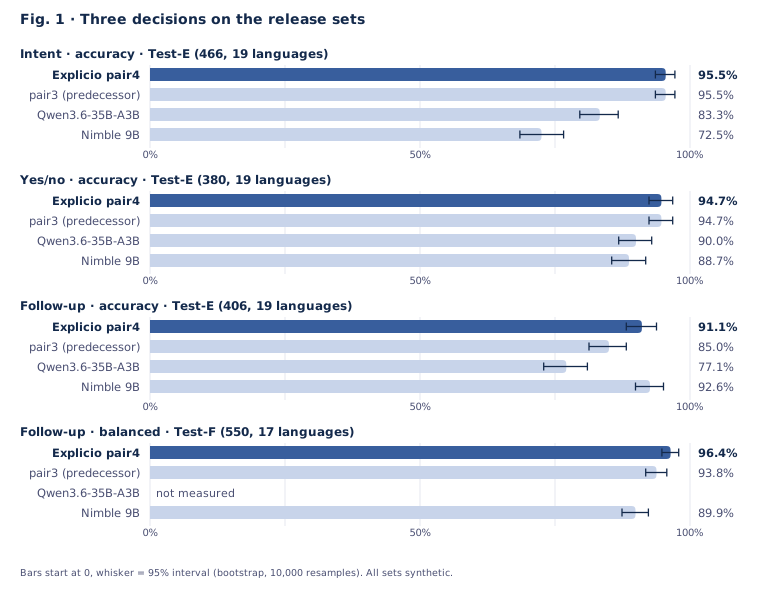
Why 3 decisions are made before every search: Classic word lists get only 34.5 % right on colloquial yes/no answers (“that’ll do”) and only 57.6 % on follow-up questions. Our own pair4 model (307M parameters on mmBERT-base, MIT licence) reaches 95.5 % on intent, 94.7 % on yes/no and 96.4 % balanced accuracy on follow-up questions (Test-F).
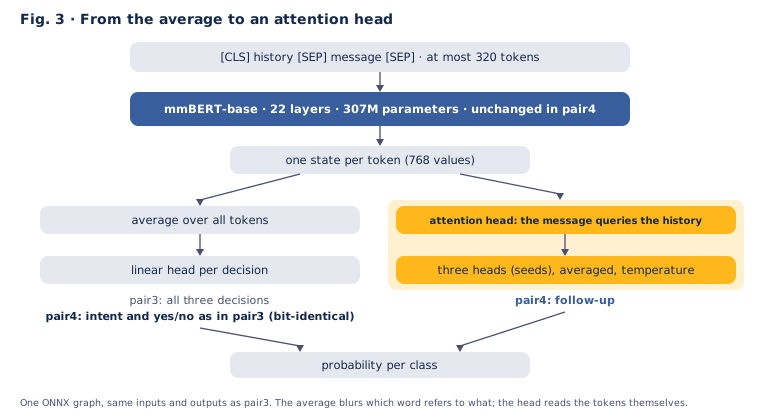
The technical innovation (attention head instead of mean pooling): A newly developed 0.89M-parameter attention head reads the token relationships between history and message directly from the frozen encoder and closes 83 % of the gap to a fully trained model – while intent and yes/no remain bit-identical (Δp = 0) across 3,700 cases.
Speed & proven safety: pair4 computes in 62.8 ms (p95) on 2 CPU threads of the Explicio Box (only 1,526 MiB RAM, 0 MB GPU memory) and has a statistically proven error bound of 4.8 % at 95 % confidence (95.3 % coverage). Trained 100 % without customer data.
Embedded figures
Fig. 1: Three decisions on the release sets (Explicio pair4 vs. pair3 vs. Qwen3.6-35B-A3B vs. Nimble 9B)Fig. 3: From mean pooling to the attention head
SCIENTIFIC HONESTY · CHECKLIST FOR DECISION-MAKERS
Five questions you should ask every provider of a knowledge assistant – including us.
01Which decisions are made before the search – and who makes them?A rigid word list (34.5 % hit rate), an expensive language model (83.3 %) or a specially calibrated model such as pair4 (95.5 % / 96.4 %)?
02On which sets was it measured – and how often has the model seen them?A success figure on a test set that was read along during development is worthless. At Explicio, every model sees the blind release sets (Test-E and Test-F) exactly once.
03Is there a statistically proven error bound – and what happens below it?A model that does not know its own uncertainty cannot declare it. pair4 works with a statistically proven bound (< 4.8 % error at 95 % confidence) and, when in doubt, asks the human.
04Where does the decision run – and what does it cost?Does every up-front check block a GPU (151 to 524 ms), or does it run deterministically in 62.8 ms on the local CPU so that the GPU stays free for the answers?
05Where is another model better?“A comparison that does not say so is an advertisement.” That is why our whitepapers document every limit and every point at which third-party models led on individual sentences.
OUTLOOK · ONGOING RESEARCHExplicio pair5 (goal: < 40 ms for all 3 decisions on CPU, microsecond cascade & task adapters)
EXPLICIO® CAMPUS · THESES & RESEARCH
Explicio® Campus: where science becomes industrial reality.
We believe in the close interlocking of research and industrial application. We are currently building cooperations with universities and chairs – you do not have to wait for that: write to us and we will check whether it fits.
THESESOpen supervision of thesesPractice-oriented bachelor's and master's theses, dissertations and research-oriented term papers on knowledge extraction from speech, video and documents, hybrid retrieval and evidence chains, edge AI on compact hardware and decentralised compute infrastructure.
COMPUTE TIMEGPU compute time case by caseResearch often fails for lack of compute. For suitable projects we provide compute time on our GPU boxes – case by case, by arrangement, outside operating windows.
SPARRINGExpert sparring & seminarsOur team gives guest lectures, leads seminars and provides methodological support in designing ontologies, retrieval pipelines and evaluations.
DATAReal questions instead of toy datasetsResearch real questions of European mid-sized industry – industrial data only with the explicit release of the respective customer and in full respect of data protection and data sovereignty.
University collaborations, theses & direct contact